Guide · Travel time

Best time for northern lights in Tromsø: month by month

Darkness, weather and the time of night determine whether you see the lights. Here you compare all months of the season with real climate data and find the period that fits your trip.

Check availabilityfrom $61 · free cancellation

Editorial tromsopolarlicht.comUpdated on October 3, 20266 min read9 sources

Tonight in Tromsø

Are there auroras tonight?

…

·Kp peak tonight ·
·Cloud cover 21:00 to 02:00 ·
·dark enough (season)

Clouds per hour tonight

How we assess this

A rule of thumb, not a promise: darkness is required first. Next, the clouds: from 70% cloud cover the chances are poor, under 30% with Kp 2 or more they are good, in between luck helps. Kp is the measure for the disturbance of the Earth's magnetic field, 0 to 9.

Updated: · every 12 hours · Kp: NOAA Space Weather Prediction Center · Cloud cover according to MET Norway
The past 30 days

Activity over the past weeks

quiet (under 2)moderate (2 to 4)active (4 to 5)strong (5 and up)Clouds at night (forecast; “·” = before measuring began)
DayHighest KpActivityCloudsOur take

Kp values from NOAA, the daily maximum for each day.Clouds: MET Norway, forecast from 21:00 to 02:00, since recording started.

In short

01Season
From late August to early April, as soon as the sky is dark and clear.1
02Polar Night
From about November 27 to January 15 the sun stays below the horizon.2
03Time of day
Most active between about 8 p.m. and 2 a.m.3
04Our pick
February and March: long nights, more daylight and fewer rainy days than in autumn.4
05Today
The live estimate on this page shows you the chances for the coming night.

The season in Tromsø

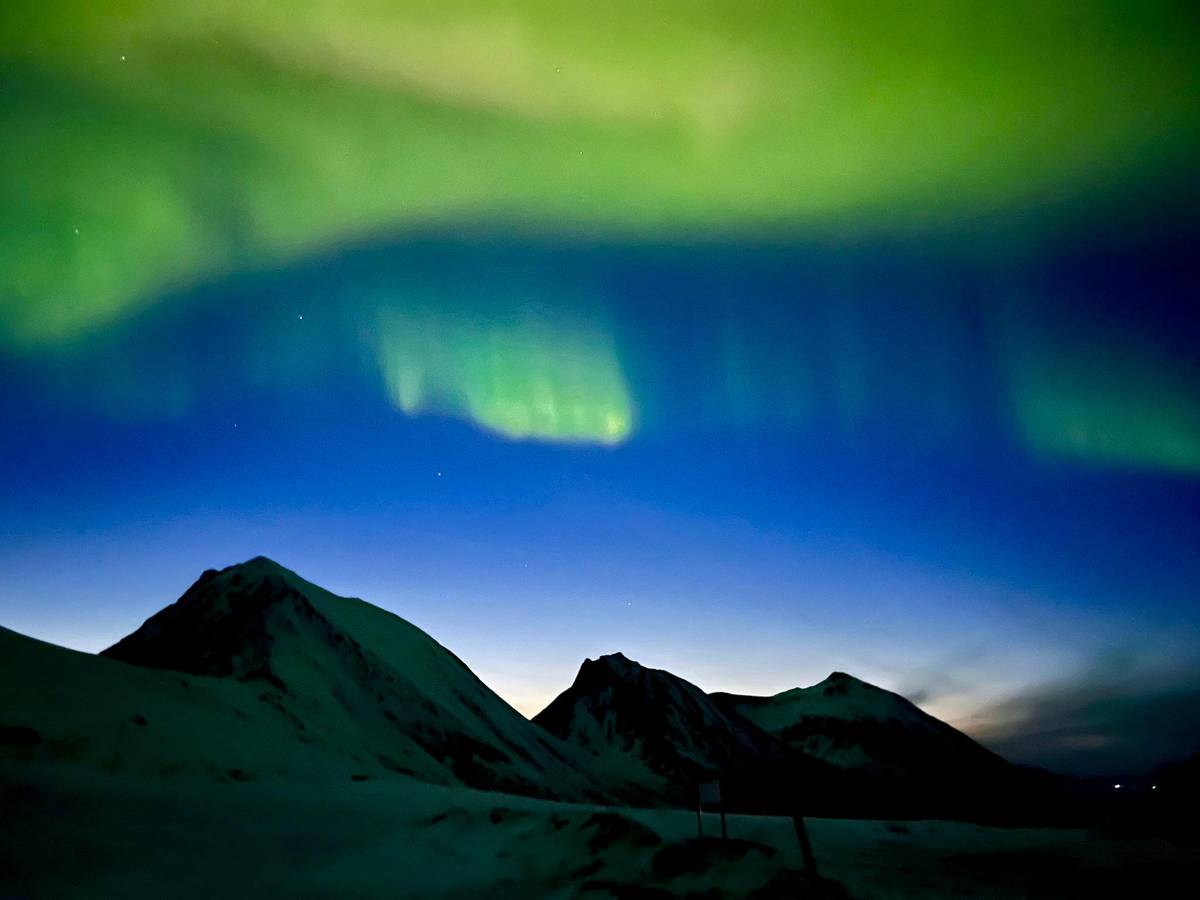
The northern lights shine over Tromsø all year round, but you only see them when the sky is dark enough. According to Visit Tromsø, that is the case from late August to early April, provided the sky is also clear.1 In summer, on the other hand, the sun does not set for weeks: the midnight sun usually lasts from around May 20 to July 22.5

Within the season, there is no month in which the lights are guaranteed, and no month in which they are ruled out. Tromsø sits directly beneath the aurora oval, the ring of light above the geomagnetic North Pole.6 Activity is therefore present on many nights. What sets the months apart is the length of darkness, the weather, and the temperatures.

That is why a comparison that brings all three points together is worth it. The chart and the table on this page show you, for each month, how long the sun stays above the horizon, how warm or cold it is, and on how many days it noticeably rains or snows. The data comes from the NOAA station in Tromsø, averaged over the years 1991 to 2020.4

The Year

The Season at a Glance

  1. End of August

    Start

    The first dark nights of the season.1

  2. September

    Reflections

    Mid-month still 13.1 hours of sun.4

  3. October

    Changeable

    On average, 13 days with precipitation.4

  4. November 27

    Polar Night

    The sun stays away until about January 15.2

  5. February

    festival

    2027, from February 11 to 20.7

  6. Early April

    End

    The nights get too bright.1

Autumn: September and October

Autumn is the time for reflections. Lakes and fjords are still open, and on calm evenings the water doubles the green arches. In mid-September, the sun is still above the horizon for 13.1 hours, and the average high temperature is 10.9 degrees.4 So you freeze less, but you have to wait longer for it to get dark.

The downside of autumn is the weather. In October, the station counts an average of 13 days with at least 2.5 mm of precipitation and a total of 129 mm for the month, as much as in no other month of the year.4 Cloudy evenings are then common, and a tour that chases a clear sky is especially valuable at this time.

If you travel in autumn, you should plan for several nights. One evening with breaks in the clouds is enough to experience strong northern lights over a dark lake. Autumn is especially good for travelers who also want to hike or take photos during the day without being out in deep snow.

Darkness and Weather

Sunshine and Precipitation Days per Year

Hours without sunDays with precipitationSeason
Jan: 24 h without sun, 12 days with precipitation 24 JanFeb: 16.9 h without sun, 10 days with precipitation 17 FebMar: 12.7 h without sun, 11 days with precipitation 13 MarApr: 8.1 h without sun, 9 days with precipitation 8 AprMay: 2.2 h without sun, 7 days with precipitation 2 MayJun: 0 h without sun, 7 days with precipitation 0 JunJul: 0 h without sun, 8 days with precipitation 0 JulAug: 6 h without sun, 9 days with precipitation 6 AugSep: 10.9 h without sun, 12 days with precipitation 11 SepOct: 15.3 h without sun, 13 days with precipitation 15 OctNov: 20.4 h without sun, 11 days with precipitation 20 NovDec: 24 h without sun, 12 days with precipitation 24 Dec
The bars show hours without sun (midmonth); the dots show days with at least 2.5 mm of precipitation. Tromsø station of NOAA, averages from 1991 to 2020.4

Month by Month

All months at a glance

MonthDaylight (h)Darkness (h)High / LowPrecipitation DaysNorthern Lights
Jan024-1 / -5 °C12yes
Feb7.116.9-1 / -6 °C10yes
Mar11.312.71 / -4 °C11yes
Apr15.98.14 / -2 °C9until early April
May21.82.29 / 2 °C7no
Jun24013 / 6 °C7no
Jul24016 / 9 °C8no
Aug18615 / 8 °C9from late August
Sep13.110.911 / 5 °C12yes
Oct8.715.35 / 1 °C13yes
Nov3.620.42 / -2 °C11yes
Dec0240 / -4 °C12yes

Hours of daylight in the middle of the month, temperatures as the average of daily highs and lows, days with at least 2.5 mm of precipitation. NOAA, period 1991 to 2020.4 Season according to Visit Tromsø.1

Seasons compared

Autumn, Polar Night, or Late Winter

Autumn, September and October mild

Autumn

September and October

High
10.9 C in September
Sun
13.1 hrs mid-September
Good for
Reflections
Pick your month
Polar Night, Late November to mid-January Darkness

Polar Night

Late November to mid-January

Sun
0 hours in mid-December
Low
-3.9 C in December
Good for
Long nights
Pick your month
Late Winter, February and March Recommended

Late Winter

February and March

Precipitation Days
10 in February
Sun
11.3 hrs mid-March
Good for
Day and Night
Pick your month

Decision helper

Which time period suits you?

What matters most to you?

Polar Night

Approximately from November 27 to January 15 without sunshine.2

February or March

Mid-March, 11.3 hours of sun.4

September

Average highs of 10.9 degrees.4

Festival in February

2027, from February 11 to 20.7

The Northern Lights can appear throughout the night, but they are often most lively from about 8 PM to 2 AM.

Visit Tromsø Region ASEnglish original, translated · Source 3

Polar night: November to mid-January

From late November begins the time without sunshine. The polar night lasts in Tromsø roughly between 27 November and 15 January.2 For the northern lights this means very long nights: it is already dark by the afternoon, and the time to look at the sky stretches deep into the night.

The day during this period, however, is no real day. Instead of sunlight, there is a blue twilight at noon, which many visitors find especially beautiful. In December, the average high temperature is 0.3 degrees, and the low temperature is minus 3.9 degrees.4 That is milder than many expect for the Arctic, because the sea warms the coast.

Even during the polar night, the weather is the decisive factor. In December and January, the station counts an average of 12 days each with at least 2.5 mm of precipitation.4 Around Christmas and New Year, Tromsø is also in high demand. If you travel during this time, it is better to book your tour early and plan buffer time for cloudy evenings.

Checklist

Plan your trip at the right time

01

Before booking

  • Choose the month based on darkness and weather
  • Plan for several nights
  • Check festivals and holidays
02

On site

  • Check afternoon cloud cover
  • Warm clothing for the late hours
  • Book a tour with a second attempt

Cost calculator

What your tour costs in season

Choose the tour and enter how many of you there are.

people 2

Total from$122

per participant from $61

Check availabilityfree cancellation

Converted using the ECB reference rate from the starting prices on GetYourGuide. The booking will show you the exact cost.

Video

Northern lights trips: polar day, polar night, and the right time

The video only loads when you tap Play on your tip.

Late winter: February and March

For many, late winter is the most beautiful combination. The nights are still long, but during the day the light returns. By mid-February, the sun is above the horizon for 7.1 hours, and by March it is already 11.3 hours.4 This way, you can go on excursions during the day and still hope for the northern lights in the evening.

The weather also has slight advantages in February. The station then counts an average of 10 days with at least 2.5 mm of precipitation and 94 mm for the month, less than in October or December.4 The average low temperature is a bit lower at minus 5.7 degrees.4 Clear, cold nights are common at this time, and they are good for the northern lights.

In February, the Northern Lights Festival also takes place, a city music festival. For 2027, it is scheduled from February 11 to 20.7 If you want to combine concerts and the northern lights, these days offer a special opportunity, but you should book accommodation and tours early.

The best hour of the night

Besides the month, the time of day also matters. According to Visit Tromsø, the lights can appear at any hour of the night, but the most active phase is often between around 8 PM and 2 AM.3 This span is a good framework for your evening if you do not want to spend the whole night outside.

In autumn and late winter, the start shifts later because it gets dark later. During the polar night, you can start earlier. The northern lights can also appear several times in one night, with calm phases in between. Whoever goes back to the hotel after the first arc sometimes misses the brightest moment. Patience almost always pays off in Tromsø.

The tours in Tromsø are built around these hours. The safari on this page lasts 6 hours and covers a large part of the active time. If you are out on your own, it is best to plan a warm break and then head out again around midnight.

How high are the chances really?

Many people ask about the probability of the northern lights in Tromsø, as if there were a fixed number. There isn't, because two things have to come together independently of each other: activity in the sky and gaps in the clouds above you. The activity is present on many nights in Tromsø thanks to its location beneath the oval.6 The clouds are the real unknown.

That is why we show you no made-up percentage on this page, but real data. The live estimate shows the chances for the coming night. Below it, you see the nights of recent weeks with the highest Kp value and the cloud cover. This gives you a feel for how often both came together in recent weeks.

The most effective way to increase your chances is time. If you spend several nights in Tromsø, you get multiple tries and can sit out a cloudy night. If you have little time, choose a tour that avoids the clouds. Tours then often seek the drier inland, if necessary Finland.8

Our recommendation for your trip

If you can choose freely, we recommend February or March. The nights are long enough, daylight returns, and on average there are fewer days with precipitation than in October.4 You can take excursions during the day and hope for the northern lights in the evening, without having to decide between the two.

If you want to experience the polar night yourself, travel in December or early January. Then the darkness is part of the experience, and the nights give you the most hours for looking up. If you are looking for reflections in the water and prefer milder temperatures, choose September.

No matter which month it is: plan for several nights, keep an eye on the forecast, and book a tour so that you have a second chance if needed. The safari on this page offers an Unlimited option, with which you can join again if luck is not on your side.

Secure your spot

Maybe it is already glowing tonight over the fjord.

Book without prepayment, pay later, cancel for free up to one day before.

You ask,we answer.

When does the season start?

End of August. From late August to early April, the northern lights are possible when the sky is dark and clear.1

When is polar night?

Around late November to mid-January. Without sunrise, it stays dark roughly between 27 November and 15 January.2

Which month has the most days of precipitation?

October. On average, 13 days with at least 2.5 mm of precipitation.4

Is there northern lights in summer?

Not visibly. The midnight sun hangs in the sky roughly from 20 May to 22 July.5

What time of day gives you the best chances?

Often in the late evening. The lights are often most active between roughly 8 PM and 2 AM.3

How cold should you expect it to be?

Colder than Central Europe, but mild for the Arctic. The average winter temperature is around minus 4 degrees.9

When is the Northern Lights festival?

In February. 2027, from February 11 to 20.7

Tromsø: Northern Lights Safari with Guides and Photos 4.6 (8,349) · Free cancellation Usually sells out 6 days ahead from$61 Check availabilityfrom $61 · reserve, pay later